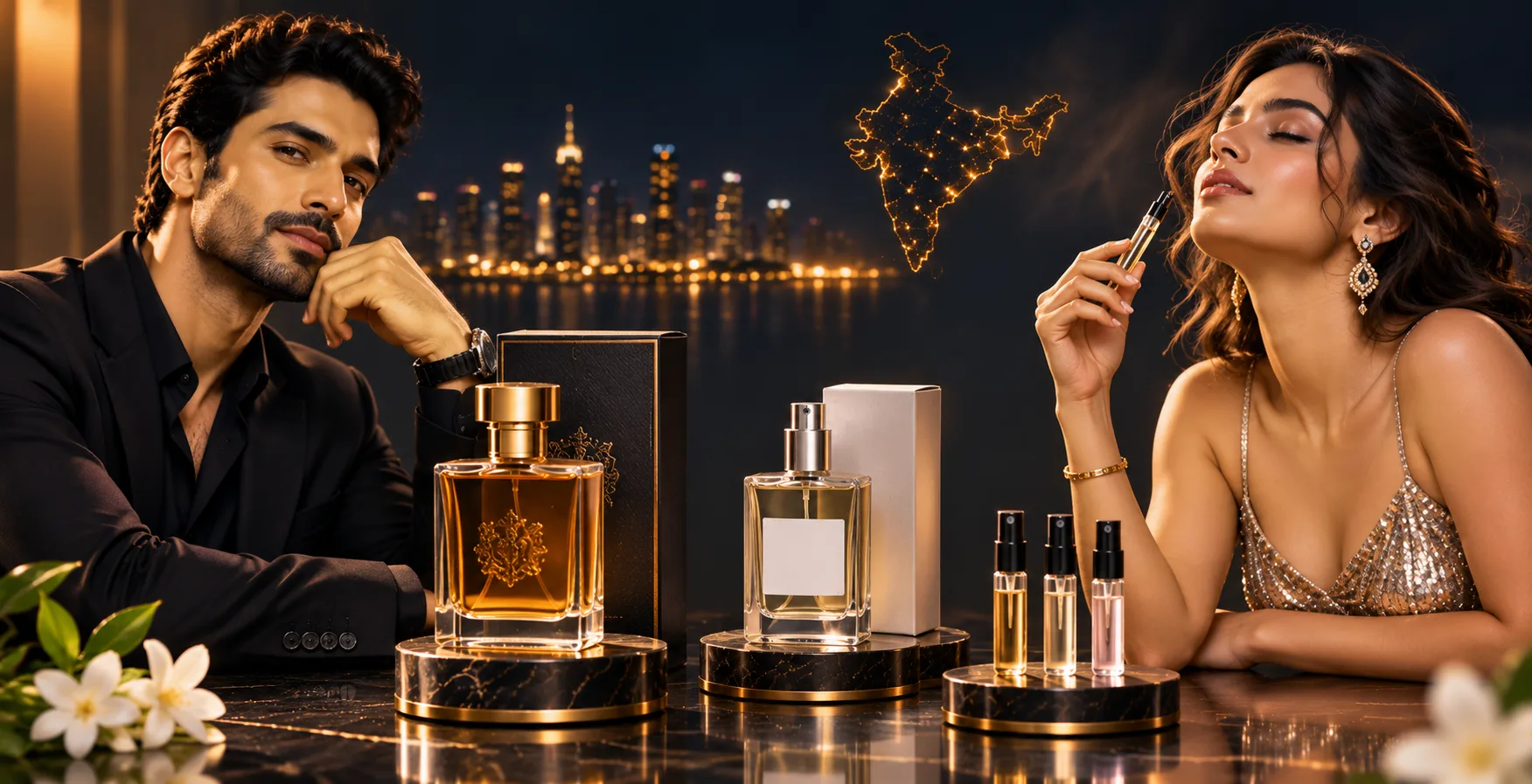

A beautiful fragrance can be an expensive blind buy. The opening may sound perfect on paper, yet the scent can feel completely different after a few hours of wear. That is why the format you buy matters almost as much as the fragrance you choose.
Here is the short answer: choose a decant or sample when you want to try a scent with less upfront commitment; consider a tester when you already want a substantial quantity and understand its packaging; choose a retail bottle when you love the fragrance and want its standard presentation. A tester is not the same thing as a decant, and a sample is not necessarily the same as either.
Acordell lists selected decants or sample sizes through its support channel and offers retail/tester variants for certain full-size fragrances. Availability and exact packaging must be confirmed on the current listing. Start by browsing the Acordell collection or ask its team which decants are currently available.
Acordell lists selected decants or sample sizes through its support channel and offers retail/tester variants for certain full-size fragrances. Availability and exact packaging must be confirmed on the current listing. Start by browsing the Acordell collection or ask its team which decants are currently available.
Decant, sample, tester and retail bottle: the differences
| Format | What you receive | Best reason to choose it | What to confirm |
|---|---|---|---|
| Decant | A portion of fragrance transferred from a larger bottle into a separate smaller vial/atomiser | Try an unfamiliar scent across multiple wears | Original source, stated volume, atomiser, hygiene and availability |
| Sample | A small amount, sometimes an official brand vial and sometimes retailer-filled (read the listing) | First impression or limited testing | Whether brand-issued or decanted; size and packaging |
| Tester | Typically a full-size bottle intended for display/demonstration; may use different external packaging | A full-size purchase where the buyer accepts the stated packaging | Bottle condition, seal, box, cap, retail/tester variation |
| Retail bottle | The standard consumer retail presentation of the named fragrance and size | A familiar fragrance, keeping or gifting in standard packaging | Exact size, concentration, variation and current price |
These are format descriptions, not claims that every seller follows identical packaging practices. Read each product listing and clarify anything missing before ordering.
What is a perfume decant?
A perfume decant contains fragrance moved from an original larger bottle into a smaller container. It is a way to experience the liquid without committing to the full-size presentation. A decant usually does not include the brand’s original retail bottle or carton, and the atomiser may differ from the original bottle’s sprayer.
Decants are especially useful for unfamiliar niche compositions, changes in scent preference, or testing whether an attractive top note remains enjoyable through the heart and dry-down. The key trust question is straightforward: where did the liquid come from, and how is the decant identified and handled?
Acordell says selected fragrances may be offered as decants or samples. Because the selection changes, check with Acordell for today’s list and sizes rather than assuming any specific product is available as a decant.
What is a perfume tester? Is it the same as a decant?
No. A tester is normally a product bottle intended for demonstration. It can contain the same named fragrance and concentration as a retail product, but presentation details such as the carton, labelling or cap may differ. A tester should not be described as “used”, “unboxed”, “without a cap” or “identical to retail” unless the particular listing actually confirms those details.
For example, Acordell’s Xerjoff 1861 Naxos EDP listing displays separate 100ML RETAIL and 100ML TESTER choices. Its Marc Antoine Barrois Ganymede EDP listing also shows retail and tester options. On either page, select the exact product type and review the displayed price before checkout. Contact support if the packaging/condition is unclear.
A decant, by comparison, is a smaller portion transferred into another container. A full-size tester and a small decant are not interchangeable descriptions.
When should you choose a decant?
- You have never worn the fragrance on skin and want to avoid a blind buy.
- The full bottle is a significant purchase and you want a few ordinary-day wear tests first.
- You are comparing very different styles, such as a fresh aromatic scent and a honeyed, tobacco-led scent.
- You want to test the opening, heart and base notes instead of judging from a short review.
- You travel or prefer to carry smaller volumes, subject to packaging and airline rules.
A decant is not always the cheapest option per millilitre. You are often paying for flexibility and a smaller initial purchase. That can still be valuable if it helps you avoid an unsuitable full bottle.
When does a tester or retail bottle make more sense?
Consider a tester if you already know you want the fragrance, you need the listed full-size amount, and the seller clearly explains the tester’s condition and packaging. Compare the price only after selecting the correct variation; a product card’s range or “from” price is not a substitute for the chosen variant’s final price.
Choose the retail bottle when presentation matters, you want the standard box, or you are buying a fragrance you have already tested and enjoyed. For a repeat purchase, a full bottle can be more economical by volume, but only when the current prices and sizes support that conclusion.
How to calculate value without guessing
Use a simple comparison: cost per millilitre = total selling price ÷ labelled volume in millilitres. For example, a hypothetical 5 ml decant at ₹500 costs ₹100 per ml, while a hypothetical 100 ml bottle at ₹8,000 costs ₹80 per ml. These numbers are illustrations, not Acordell product prices.
Then add the real decision question: will you wear the fragrance enough to justify the larger quantity? A full bottle can win on cost per ml and still be poor value if it sits unused. A decant can cost more per ml and still be the better purchase for an unfamiliar scent.
A practical buying rule
Test first when the scent is unfamiliar. Choose a full-size tester or retail bottle after you have worn it through normal daily conditions and confirmed the specific variation you want.
How to test a fragrance before buying the full bottle
Wear 1: judge the opening and the dry-down
Start with a small application on clean skin, following the product’s directions. Note the first impression, then check again after roughly 20–30 minutes and later in the day. Top notes can be fleeting; the heart and base can change the character considerably. The Perfume Society recommends experiencing fragrance on skin rather than relying only on a paper blotter.
Wear 2: use it on an ordinary day
Try the fragrance during a normal office day, commute or weekend routine, not only during a special evening. Note whether the scent remains comfortable indoors, outdoors, in humid conditions or in air-conditioned spaces. Personal tolerance and scent perception matter more than an online claim that something is “beast mode”.
Wear 3: compare it with something you already own
If you have a familiar favourite, compare the mood, scent family and frequency with which you would actually wear each one. Avoid layering the test scent with other perfumes during evaluation. Note whether you still want to wear it the next day. If irritation occurs, stop using the product.
Fragrance examples worth comparing by format
The following are live Acordell product pages that help illustrate different fragrance styles and price points. They are linked as full product listings, not as a promise that a decant is currently available.
Xerjoff 1861 Naxos EDP: warm, honeyed and distinctive
The Acordell product description lists citrus and lavender in the opening, with honey, cinnamon, tobacco, tonka and vanilla later in the profile. If this combination sounds intriguing but unfamiliar, testing on skin before a large purchase is sensible. View Xerjoff 1861 Naxos EDP.
Marc Antoine Barrois Ganymede EDP: mineral and woody character
Acordell describes Ganymede with mandarin and saffron, osmanthus and immortelle, then a woody base. This is a useful example of why a simple “fresh or sweet” label does not tell the complete story. View Marc Antoine Barrois Ganymede EDP.
Davidoff Cool Water EDT: a different concentration and scent direction
If you are considering an everyday fresh-style fragrance, the Davidoff Cool Water EDT listing is another relevant starting point. Read the exact product variation and the EDT label; concentration alone cannot guarantee a fixed number of hours on skin.
French Avenue Liquid Brun EDP 100ml: compare another fragrance family
Shoppers interested in the Middle Eastern section can also look at French Avenue Liquid Brun EDP 100ml. Use its product page as a starting point for comparing scent profiles and deciding whether to ask for a smaller trial first.
You can also compare the broader niche fragrance collection, designer fragrances and Middle Eastern fragrances without committing to one brand based only on popularity.
Authenticity and packaging: questions to ask before ordering
- Is the fragrance an official brand sample, a retailer-filled decant, a tester bottle or a retail bottle?
- Is the product name and concentration identical to the one on the source bottle or original listing?
- What is the exact labelled size, and is a spray atomiser supplied?
- For a tester, what packaging, cap and bottle condition should I expect?
- Are the current price, shipping charges and issue-reporting terms clear before payment?
Acordell publicly states it sells genuine fragrances and has support information on its website. As with any purchase, review the current product details and policies at checkout. Check the current delivery and issue-reporting terms at checkout instead of relying on older screenshots or third-party quotes.
Frequently asked questions
Are perfume decants original?
A decant can contain authentic fragrance transferred from an original bottle, but authenticity depends on the source and handling. Ask the seller how the liquid was sourced and labelled.
Is a tester bottle fake or second-hand?
Not by definition. “Tester” describes a demonstration-oriented product format, not proof of counterfeit or prior use. Confirm the specific bottle condition, packaging and seller details.
Is a tester cheaper than a retail bottle?
Sometimes, but not always. Compare the current selected variants, bottle sizes and final selling prices rather than assuming the tester is discounted.
Can I buy a decant of every fragrance?
No availability should be assumed. Acordell says selected fragrances may be available in smaller sizes; ask the store for the current list.
Do EDP and EDT labels guarantee longevity?
No. Concentration categories can be helpful, but scent performance also depends on formulation, skin and conditions. Assess the actual fragrance.
Should I buy a full bottle without testing?
You can, but testing first may reduce the chance of an unsuitable purchase. This matters especially when you are unfamiliar with the scent family or paying a premium for a bottle.
Final verdict: buy the format that matches your certainty
If you are curious, start small. If you already love the fragrance and understand the packaging, a tester may be worth comparing. If standard presentation and familiarity matter, choose the retail bottle. The right choice is not the one with the biggest discount label; it is the one you will enjoy wearing.
Browse Acordell’s current fragrance collection or contact the team to ask about available decants before making your next purchase. If you are selecting a fragrance for someone else, use the Acordell perfume gift guide as an additional decision aid.
Editorial note: Prices, product variants, stock and decant availability change. Confirm details on the current product page or with Acordell support before paying.